Landscape Photography Spots in Gran Canaria — A Local’s Guide
Gran Canaria offers some of the most varied landscape photography spots in Europe — and this guide covers four of the best. The island is often called a “continent in miniature” — and for good reason. Within a single island barely 50km across, you’ll find volcanic coastlines, misty highland forests, desert dunes, and lush green valleys. For landscape photographers, it’s an extraordinary playground.
I’ve been photographing Gran Canaria since 2020, and in that time I’ve explored most of the island with my camera. In this guide, I’m sharing four locations that never fail to deliver — places I return to again and again because the light, the geology, and the atmosphere are simply unlike anything else I’ve seen.
These four Gran Canaria landscape photography spots cover the full range of what the island has to offer — coast, valley and mountain. Whether you’re a visiting photographer planning a trip, or a local looking for new ground to explore, these spots are worth your time.
1. El Confital — Where the Atlantic Meets Volcanic Rock
El Confital is a protected natural area on the northern edge of Las Palmas de Gran Canaria, just a short walk from the city. What makes it special for photographers is the dramatic juxtaposition: raw, jagged volcanic rock formations meeting the open Atlantic, with the city skyline visible in the background.
Best time to shoot: Around sunset. The light descends from the west and wraps the black basalt in warm golden tones, creating a strong contrast with the deep blue of the Atlantic. The evening sea breeze can add movement to the surface, which works beautifully with long exposures
What to bring: A tripod is essential here. The rocks are uneven and the spray from the waves can be intense, so protect your gear. A polarising filter helps manage reflections in the rock pools.
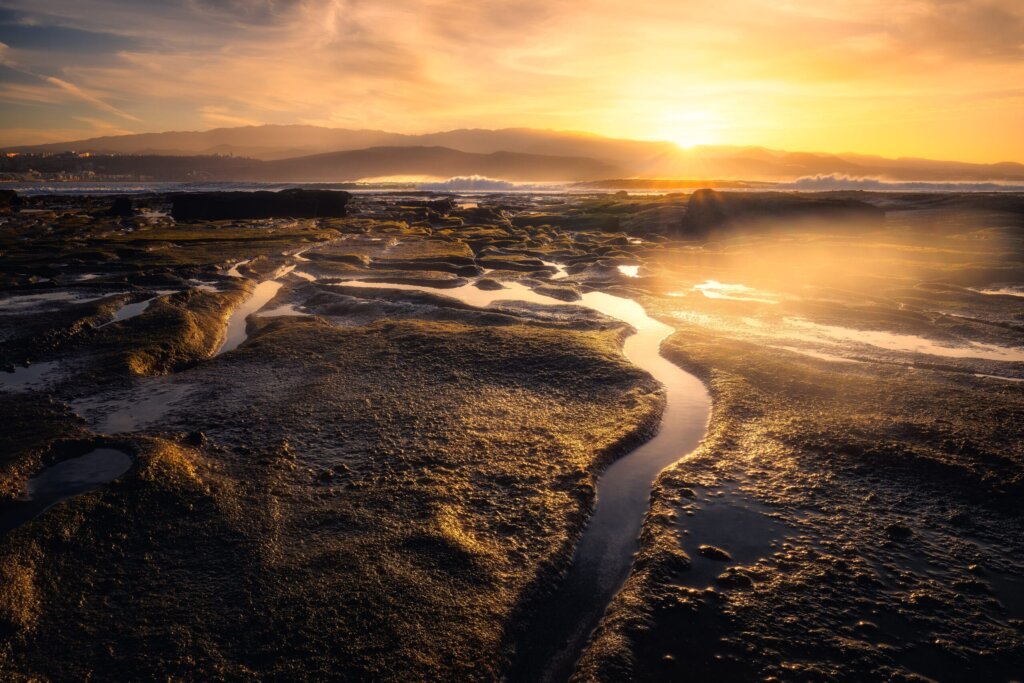
What to look for: The rock pools at low tide create natural leading lines toward the horizon. At higher tide, the waves crashing against the rock formations create dramatic long-exposure opportunities.
2. Costa de Arucas — Drama on the North Coast
The coastline near Arucas, in the north of Gran Canaria, is one of the most dramatic stretches of coast on the island. Ancient volcanic rock meets the full force of the Atlantic here — there’s no protection from the open ocean, and the waves arrive with serious energy.
This is where I photographed “Echoes”, one of my fine art prints. The challenge and the reward of this location is the same thing: the sea is unpredictable. You need patience, good timing, and respect for the water.
Best time to shoot: Sunrise and blue hour. The north coast faces away from the sunset, but at dawn the sky behind you illuminates the scene with soft, directional light. Winter swells make the waves particularly dramatic between November and March. For that, I use PhotoPills to plan the exact sunrise angle for each location.
What to bring: Waterproof covers for your gear. Long exposure filters (ND 6-stop or higher) for silky water effects. Rubber boots are a good idea if you want to get close to the waterline.
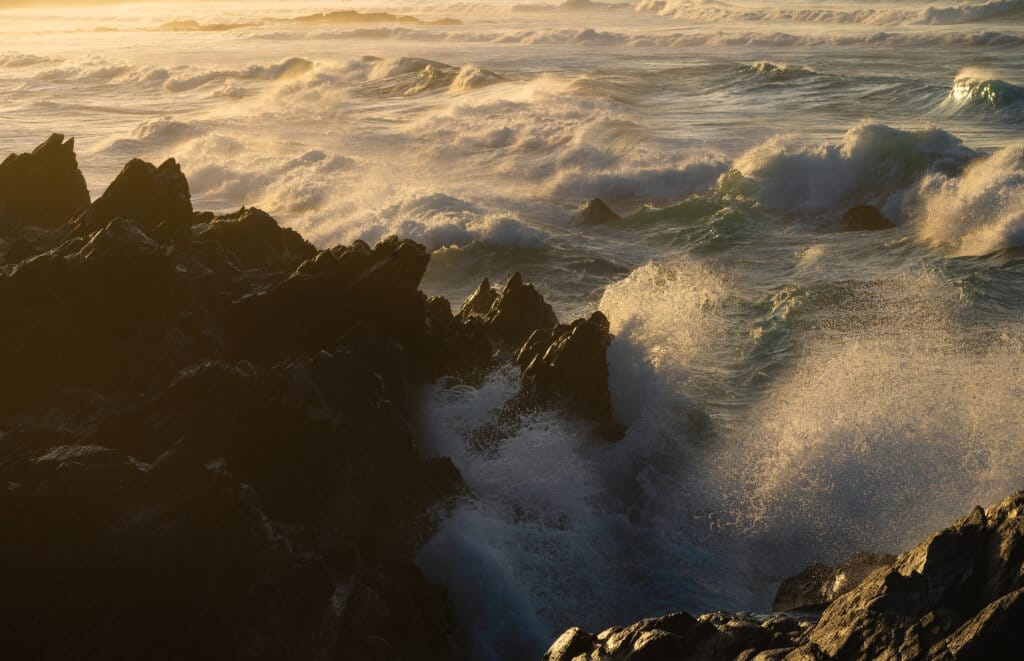
What to look for: The layers of rock strata tell a geological story — try to include them as foreground interest. The contrast between the dark basalt and the white foam of breaking waves is a classic of north coast photography.
3. Valle de Agaete — The Green Heart of Gran Canaria
If you think Gran Canaria is all desert and coastline, Valle de Agaete will change your mind. This lush valley in the northwest of the island is dramatically different from the south — green, fertile, and framed by towering mountain walls on three sides.
The valley is famous for being the only place in Europe where coffee is commercially grown. The terraced fields, fruit orchards, and the small village of Los Berrazales create a landscape that feels almost Mediterranean — a world away from the volcanic drama of the coast.
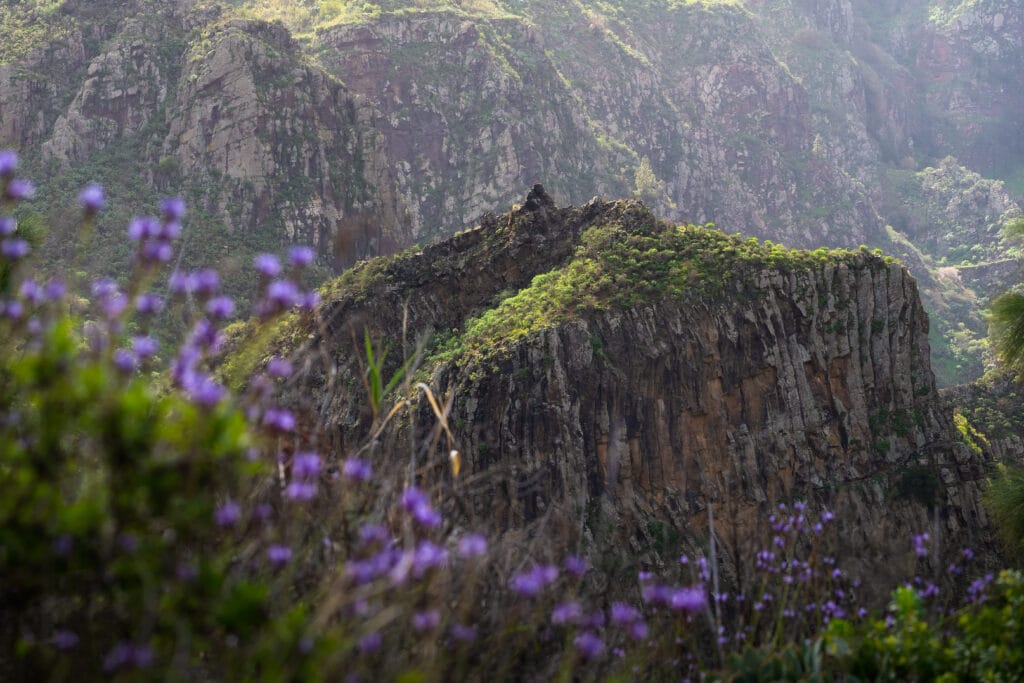
Best time to shoot: Late afternoon, when the sun descends toward the western mountains and creates golden side-lighting across the terraced fields. Spring (March–May) is particularly beautiful when the valley is at its greenest.
What to bring: A mid-range zoom (24-70mm equivalent) works well here — this is a landscape that rewards both wide establishing shots and tighter details of the terracing and vegetation. A circular polariser brings out the greens beautifully.
What to look for: The interplay between the cultivated terraces and the wild mountain walls behind them. The village of Los Berrazales makes a beautiful subject in the late afternoon light.
4. Tejeda — Mist, Mountains and the Roof of Gran Canaria
Tejeda sits in the heart of Gran Canaria, at around 1,000 metres above sea level, surrounded by some of the most dramatic mountain scenery on the island. The iconic silhouette of Roque Nublo rises above the village, and on winter mornings the entire valley fills with mist that moves and shifts like something alive.
This is where I photographed “Niebla” — one of my favourite images I’ve ever made. A solitary almond tree emerging from the heavy morning mist, with the mountains barely visible behind it. The conditions lasted about 15 minutes before the sun burned the mist away. That’s mountain photography: you wait, and when it comes, you work fast.
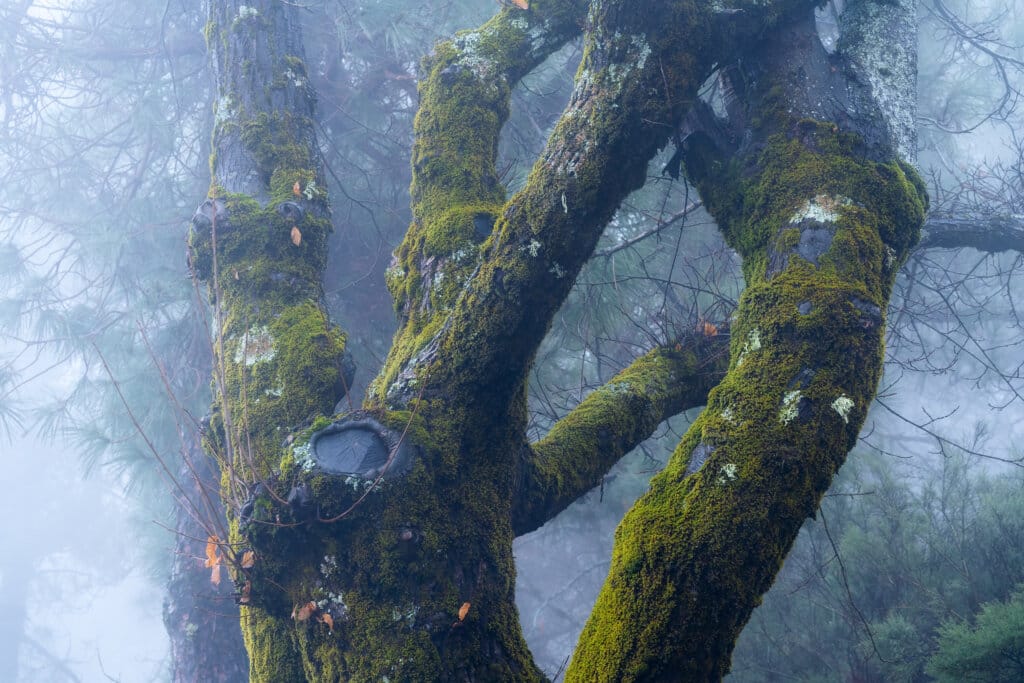
Best time to shoot: Winter mornings (November–February) offer the best chance of mist in the valley. Arrive before sunrise and be set up by the time the light begins — the mist moves quickly. Spring brings almond blossom, which turns the valley pink and white in February.
What to bring: Warm layers — even in spring it can be very cold at altitude in the early morning. A telephoto lens (70-200mm) is useful for isolating subjects within the mist. A tripod is essential in low-light conditions.
What to look for: Isolated trees emerging from the mist make powerful subjects — they create a sense of mystery and depth. The silhouette of Roque Nublo against a coloured sky at sunrise is one of the classic Gran Canaria shots.
If you’re just starting out, read my guide on 10 tips to start in landscape photography.
Final Thoughts on Gran Canaria Landscape Photography Spots
Gran Canaria rewards photographers who take the time to explore beyond the tourist beaches. The four locations in this guide represent just a fraction of what the island offers — but they’re four places I can personally vouch for, having spent countless early mornings in each of them.
If you make it to any of these spots, I’d love to see what you capture.
And if you’d like to bring a piece of Gran Canaria home, explore my fine art prints — limited edition photographs from the island, printed on archival paper and signed by hand.